Alex is Sprintlaw's co-founder and a legal technology leader. He holds law and media degrees from the University of Sydney and has been recognized by Australasian Lawyer, Lawyers Weekly and the Sydney Young Entrepreneur Awards for his work building Sprintlaw and improving access to business legal support.
Contents
Using a recognizable song in a business advertising video is rarely a one step music purchase. A track that feels ready to drop into a social ad, website explainer, or paid campaign can involve different owners, different approvals, and different limits on where the finished video can run.
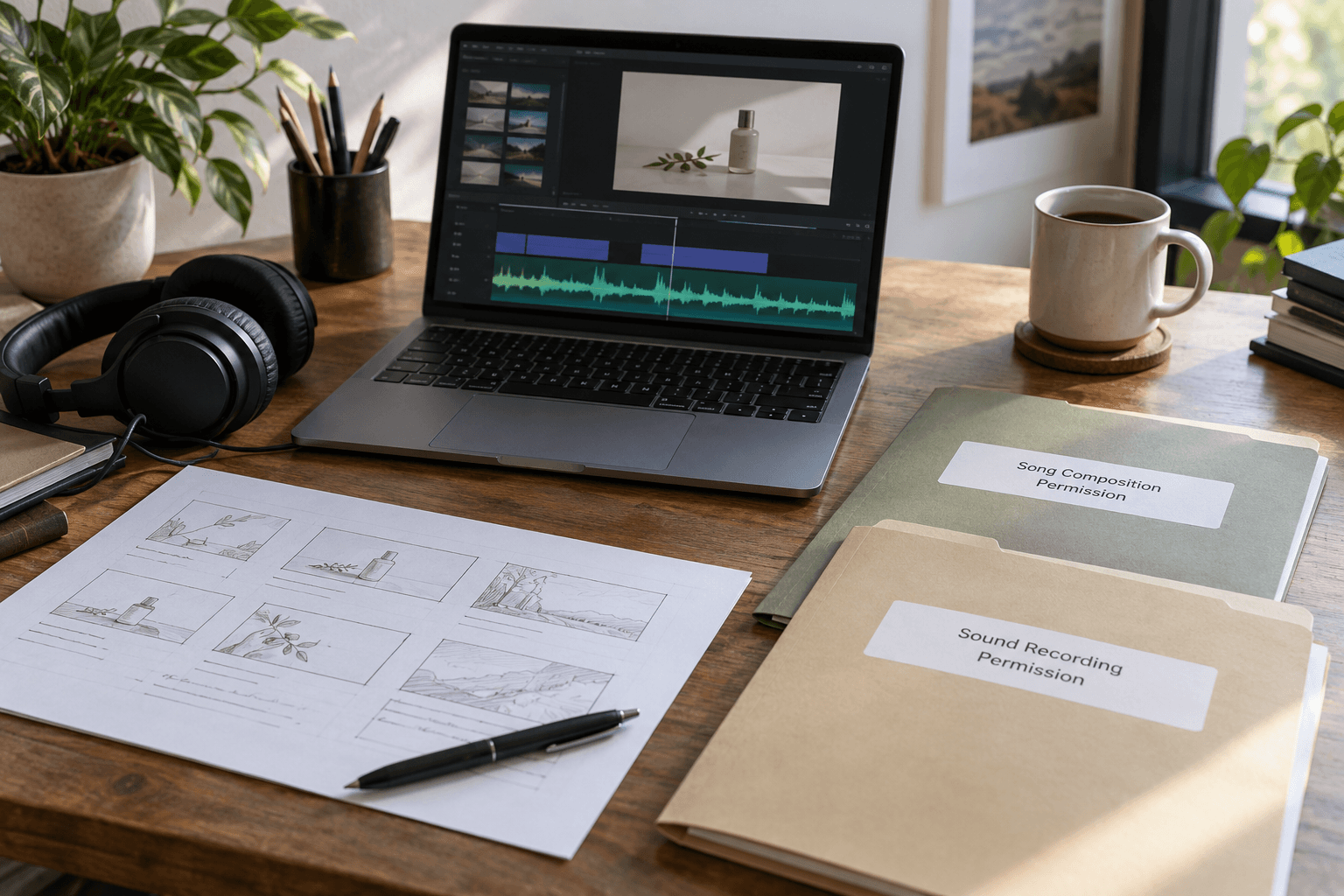
For US businesses, the key starting point is separating the song from the recording. The US Copyright Office explains that when you record a song, you may be creating two works: the musical work and the sound recording, and those rights are commonly owned and licensed separately. In practice, using an existing commercial track in a promotional video often means tracing both permission paths before launch.
This matters most when teams move fast. Cutting first and checking later can create problems once you boost the post, prepare alternate edits, or expand distribution. The discussion below focuses on the federal practical clearance chain for promotional video use, including changed use approvals and campaign scope.
The song and the recording are separate works
US copyright law treats a song and a recording of that song as different works. The US Copyright Office explains that a musical work is the underlying composition, including lyrics, while a sound recording is the recorded performance fixed in an audio file or other medium.
That matters because those rights are commonly owned and licensed separately. A songwriter or music publisher may control the composition, while a record label, performer, producer, or another rights holder may control the recording you want to use.
For a business video, start by identifying both of these assets for the exact track you want:
- the song itself, meaning the composition and lyrics
- the exact master recording, meaning the particular recorded performance you plan to place in the video
If you license only one side, you may still be missing a key permission. For example, approval from the owner of the recording does not automatically cover the composition. The reverse is also true.
The distinction also affects who your team contacts. The recording side might be managed through a label, distributor, artist, producer, or catalog owner. The composition side might be administered by one or more publishers, because songs can have multiple writers and publishing shares. A brand team does not need to know every music industry convention before making a first request, but it does need to understand that one approval may not settle the whole track.
This is why a clean clearance process usually starts with the exact version of the song. A remix, live version, re recorded version, cover, instrumental, or stems only version can have a different recording owner from the famous release. The composition may be the same, but the recording path can change. If your edit swaps audio at the last minute, the previous permission might no longer match the asset in the video.
What sync, master use and campaign permissions need to cover
The Copyright Office's guide to audiovisual music licensing distinguishes two familiar industry terms. Permission to pair the composition with visual content is commonly called a synchronization, or sync, license. Permission for the particular sound recording is commonly called a master use license. If the ad uses an existing commercial recording, check both paths.
A general public performance, venue or blanket music license should not be treated as permission to incorporate that music into an advertising video. Performance licensing and audiovisual permissions do different jobs. Check the actual grant for the video use, including the composition and any recording being used.
The Office also explains that the mechanical compulsory license does not cover audiovisual works, and there is no compulsory sync or master use license. The relevant permissions are negotiated with the owners or their representatives. This does not remove the possibility of a genuinely applicable copyright exception; those require separate, fact specific assessment.
There is no single universal license clause that covers every business advertising video. Rights are often negotiated or granted with specific limits, so the real task is to map your intended campaign to the permission you receive.
Before asking for approval, define the use as clearly as possible. The rightsholder will want to know what the business is actually doing, and your internal team will make fewer mistakes if the brief is specific.
Focus on these practical scope points:
- Channels: Will the video run on social platforms, connected TV, pre roll, your website, in app, paid search, trade show screens, or all of the above?
- Paid placements: Check whether the permission covers paid distribution as well as unpaid posts. Describe any planned boosting, sponsorship or paid placements in the request.
- Edits and versions: A 30 second ad, 15 second cutdown, vertical version, silent caption version, and region specific version may all need to fit within the permission.
- Term: How long will the business use the music in the campaign? A short launch window and a two year evergreen campaign are different asks.
- Territory: Is the campaign US only, North America, or global? Online ads often cross borders quickly, so make sure the scope reflects how the campaign will actually run.
- Creative treatment: Will you use the whole track, a chorus, a loop, a fade, or a time compressed edit? If the audio will be cut, repeated, remixed, or paired tightly with product claims, that should be disclosed.
These are not statutory magic words. They are business use details that can change whether your permission is broad enough to support the campaign you want to launch.
What does not count as permission
Several common assumptions create trouble for small businesses.
First, there is no fixed minimum clip length that is automatically safe to use without permission. The US Copyright Office says there is no hard and fast minimum amount of music you can use without getting permission when permission is required. A five second clip, hook, or beat drop is not automatically free to use.
Second, credit is not a substitute for a license. Naming the artist in the caption or end frame may be courteous, but it does not replace the rightsholder's approval.
Third, silence from a rightsholder is not consent. The Copyright Office is direct on this point: trying and failing to contact the rights holder is not a substitution for permission.
Fourth, read the actual permission or track license against the planned campaign, including any platform library terms or previous approval. The Copyright Office recommends comparing all intended uses with the rights involved and licensing the work according to the contract terms. The permitted channels, ad use, geography, and term may be narrower than the commercial terms for a content license your team expects.
What about fair use in an ad?
Fair use exists under federal copyright law, and copyright owners' exclusive rights are expressly subject to limitations and exceptions. That means you should not say commercial advertising automatically makes fair use impossible.
But you also should not build a paid campaign on a casual fair use assumption. The Copyright Act lists factors such as the commercial nature of the use, the amount used, and the effect on the potential market. Those questions are highly fact specific.
For a standard promotional video that uses a recognizable song to support branding or attract attention, relying on an exception can be risky. If your team thinks an exception may apply because the use is genuinely transformative, critical, documentary, or otherwise unusual, get qualified advice on that specific fact pattern before launch.
Using the original recording, a new recording, or a library track
A lot of confusion comes from treating all song uses as the same. They are not.
If you want to drop the well known original track into your ad, you are using both the composition and the existing sound recording. In practice, that means you need permission that covers both works.
If instead you hire musicians to create a fresh recording of the same song, you are still using the composition, but you are no longer using that original master recording. That can change who needs to approve the use and what needs to be licensed.
This distinction matters early in the project because it affects budget, timing, and creative flexibility. A new recording may avoid the need to use the original master, but it does not make the composition issue disappear.
It is also worth keeping your team away from shortcuts based on half remembered music rules. Some music uses involve statutory schemes for specific contexts, but a paid business video is not something you should treat as covered by a generic music rule you found elsewhere. Match the actual use to the actual permissions you have, and confirm the scope in writing.
Example: New recording of a known song, but the composition was never cleared
Hypothetical: A business commissions musicians to record a fresh version of a famous song for a product campaign. The team believes that because it replaced the original master, no further music clearance is needed.
That conclusion skips the separate composition question. A new recording can remove the need to use the old label controlled master, but it does not remove the underlying song from the ad. The melody and lyrics are still someone else's musical work unless the business is using a work that does not require permission or has a valid permission in place.
A studio's approval is not proof that the composition is cleared. Check whether it controls the recording rights it promises and who obtained permission for the song. If the business commissioned the remake, the business should confirm who was responsible for clearing the song itself. If the producer promised to handle it, that responsibility should be clear in writing. If nobody did, the campaign may still be missing the composition approval even though the master side was replaced.
Library music can also be useful, especially when timing is tight. But even then, the team should read the terms for the exact track and campaign. Some music libraries are built for business advertising and grant broad online use. Others are narrower, exclude paid media, limit territories, restrict edits, or only allow use inside a particular platform. A subscription dashboard is helpful only if the license it provides matches the media plan.
Build and update a clearance trail before launch
Clearing the music is only part of the job. You also need a record that someone else in the business can understand six months later when the campaign is renewed, repurposed, or challenged.
A usable clearance trail should let a marketer, founder, agency lead, or operations manager answer three questions quickly: what track was approved, who approved it, and what exact use was approved.
Keep a simple file with:
- the song title and artist
- the owner details for the composition and the recording, if different
- the final approved audio file or exact track reference
- the written permission or content license terms
- the campaign description the permission was based on
- approved edits, cutdowns, and versions
- the term and any renewal date
- the territory and channels covered
- any limitations on paid ads, boosting, or platform specific use
- contact details for the rights representative
This record matters because marketing assets often outlive the original project team. Without a reliable paper trail, businesses can easily reuse a video outside scope, re edit an ad that was approved only in one format, or keep a campaign live after the permitted term ends.
A campaign can change after the music was first cleared. Compare the new plan with the actual permissions for the composition and, where used, the recording. An earlier approval may already cover the change, but its terms need to answer that question.
The Copyright Office's practical direction is to compare your intended uses with the rightsholder's rights and make sure each use is lawfully covered. In a business video, that comparison should happen before recuts, talent pickups, media bookings, or global trafficking instructions go out.
Example: Website approval, then paid social and global expansion
Hypothetical: An agency clears a recognizable original song recording for a video on a business website. Two months later, the marketing team wants 6 second and 15 second paid social cutdowns, plus a longer brand edit for a broader campaign running in the US and overseas.
This is where teams should stop and read the actual grant, not rely on memory. Sometimes the original approval is already broad enough to cover paid placements, multiple edits, and wider territories. Sometimes it is not. The terms decide.
Because the business is still using the original commercial recording, both works remain in play: the composition and that specific sound recording. The comparison should be concrete. Did the approval cover only website use, or all online advertising? Did it allow cutdowns, alternate lengths, captioned or vertical edits, and reuse in a longer brand film? Did it cover only a named territory, or worldwide digital distribution? Did it expire after an initial launch window?
If the new use exceeds either permission, obtain the missing approval from the relevant rightsholder before publishing it. Agree who will do that work rather than assume the agency or client has already handled it. This is a practical allocation of responsibility, not a rule that every campaign has the same clearance arrangement.
If scope changes, a written amendment or reconfirmation is a sound business step, not a government filing requirement. It also helps to nominate one internal handover owner and save the exact approved audio and final exported video files so later teams do not accidentally use a different version.
Before your business commits to the song or spends on media, pause the project until you can answer these points clearly:
- Are we using an existing commercial recording, or creating a new recording of the song?
- Who controls the composition?
- Who controls the exact recording we want?
- Does the approval cover paid advertising, not just general online posting?
- Does it cover every edit, cutdown, and aspect ratio we plan to publish?
- Does it cover all channels where the ad will run?
- Does it cover the territories where the campaign may be visible?
- Does it last for the entire campaign and any planned extension?
- Do we have written evidence stored in a place the business can access later?
If the answer to any of those questions is unclear, you probably do not yet have a business ready clearance position.
FAQs
Does a platform music library settle the issue?
Not automatically. A library can be enough if its terms for the exact track actually cover the planned advertising use and the library has the rights it says it is licensing. But catalogue access is not a substitute for checking whether this campaign, this edit set, and this territory are covered.
Can I use a short clip if I credit the artist?
No. Using only a hook or brief excerpt does not by itself answer the permission question, and naming the artist does not replace approval. You still need to check the composition and recording rights.
If I make my own recording, do I still need permission?
Usually, yes, if the song is still protected and no exception applies. A new recording may avoid the need to license the original master, but it does not remove the need to clear the underlying composition.
What should I do if the media plan changes?
Compare the new plan with the written permissions before publishing. If the new channels, territory, term, paid placements, or edits fall outside the original approval, get the missing permission in writing first.
Key Takeaways
- An existing song recording can involve two separate copyright protected works: the musical work and the sound recording.
- If you want the original track in the ad, clear both the composition and the master recording. A new recording can change the recording permission path, but it does not remove the need to clear the song.
- Your approval needs to match the real campaign, including channels, paid distribution, edits, term, territory, and the planned creative treatment.
- There is no automatic safe minimum clip length, and trying but failing to contact the rightsholder is not a substitute for permission.
- Fair use exists under federal law, but it is fact specific and should not be assumed for a standard promotional video.
- Keep a practical clearance trail so future teams can confirm what track was approved, who approved it, and how the video can be used.
If you need help structuring sync and master use permissions for a business advertising video, checking license scope, recording a clearance trail, or reviewing campaign usage terms, you can reach our team on (888) 449-8437 or team@sprintlaw.com. Where legal services are required, they are provided by licensed US lawyers at ElevateNext US, LLC, a trusted US law firm, through the Sprintlaw platform.

Alex SoloCo-Founder