Alex is Sprintlaw's co-founder and a legal technology leader. He holds law and media degrees from the University of Sydney and has been recognized by Australasian Lawyer, Lawyers Weekly and the Sydney Young Entrepreneur Awards for his work building Sprintlaw and improving access to business legal support.
Contents
Usually, yes - but only if you have the right permission. If you use someone else's music in an ad without a proper license, your business could face a takedown, a demand letter, or a copyright claim.
The tricky part is that music rights aren't always obvious. A song being available on a social platform, streaming service, editing app, or music library doesn't automatically mean you're allowed to use it in a paid ad or commercial video.
The good news is that this doesn't have to be confusing. Once you know which rights to check, you can make cleaner decisions and avoid building a campaign around music you can't legally use.
Can I Use Someone Else's Music In My Ad?
Yes, you can use someone else's music in your ad if your business has permission that covers the way you're using it. For most commercial ads, that permission needs to be in writing.
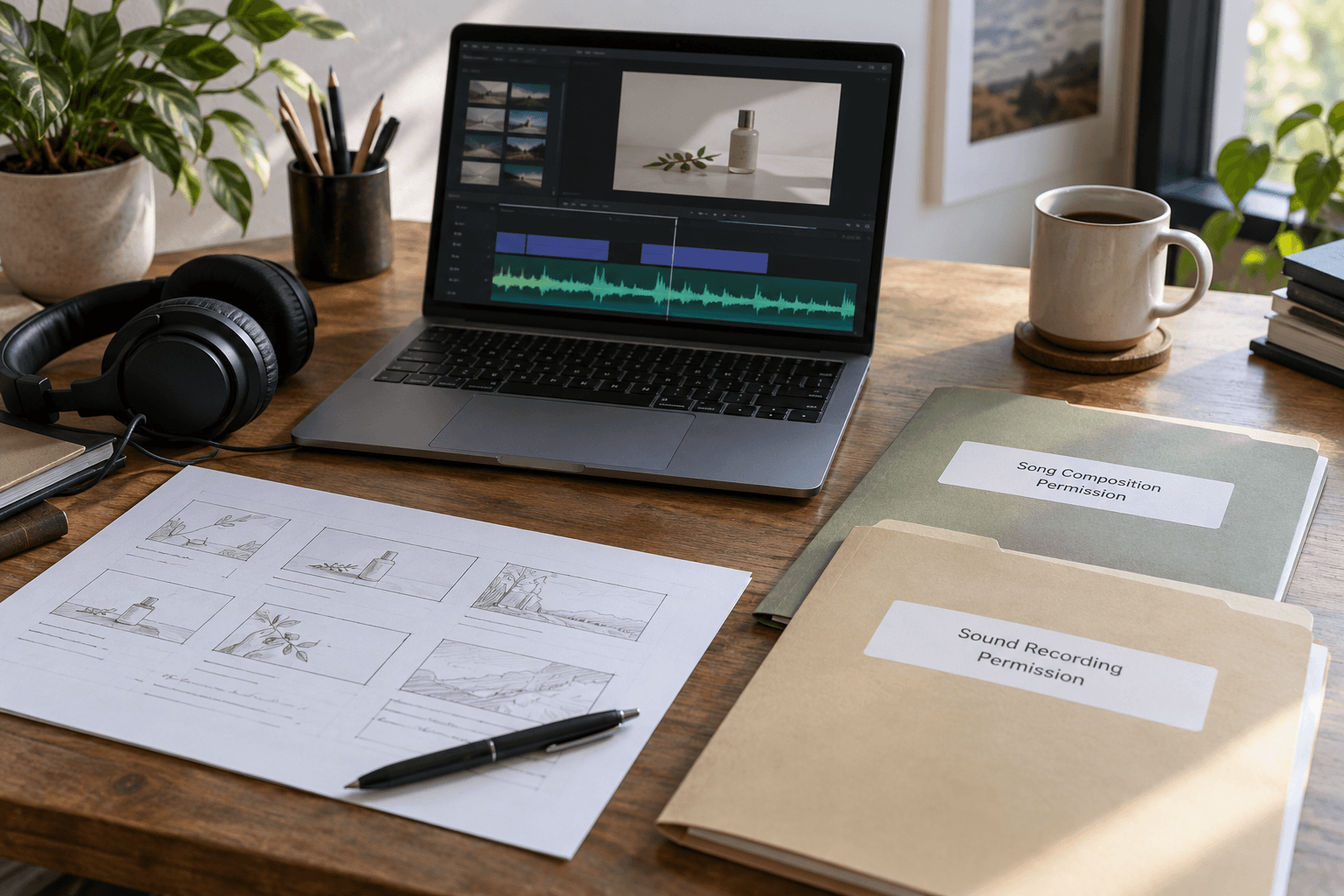
Under the federal Copyright Act, music can involve more than one copyright. In a typical recorded song, there are usually two separate rights:
- The musical composition - the melody, lyrics and underlying song, usually controlled by a songwriter, music publisher or administrator.
- The sound recording - the actual recorded version you want to use, usually controlled by a record label, distributor, artist or producer.
If your ad uses a famous recorded song, you may need permission for both. If you only get one side cleared, your campaign may still be infringing the other side.
Fair use is also a risky basis for advertising. It can apply in some limited situations under the Copyright Act, but using a recognizable song to sell a product or promote your business is usually commercial and difficult to justify. There isn't a simple rule that using 5, 10 or 30 seconds is automatically allowed.
There can also be non-copyright issues. If your ad suggests that an artist, band or celebrity endorses your product when they don't, you may create risk under the Lanham Act for false endorsement. State law may also protect a person's name, image, likeness or voice, so a soundalike or lookalike campaign can create extra issues.
Why Isn't Platform Music Enough For A Business Ad?
Platform music isn't enough if the platform license doesn't cover your exact commercial use. This is one of the most common traps for business ads.
Many social media and video platforms make music available inside their apps. That can feel like permission, but the license may be limited to personal use, organic posts, certain account types, or content that stays within that platform. Paid advertising, boosted posts, cross-posting and downloadable videos may sit outside the permission you actually have.
For example, Maya runs a skincare brand and makes a 30-second product video using a trending song from an app's music library. She posts it organically and then decides to boost it for 3 months across two platforms. The organic post might be allowed under the app's terms of use, but the paid campaign may need a separate commercial music license. If the rights owner complains, the ad can be removed mid-campaign and Maya may lose the money spent on production, media buying and creative testing.
Before you rely on platform music, check:
- whether your account is a business, creator or personal account
- whether the music can be used in paid ads, not just organic posts
- whether the permission covers your territory, such as the United States or worldwide
- whether you can use the video outside that platform, such as on your website, in email or on another social channel
- whether the platform terms of use can change or require content removal later
If the terms are unclear, don't assume the music is cleared for advertising. Get written permission or choose a track with a clearer business license.
What Licenses Do I Need For Music In A Commercial Video?
It depends on the music and how your ad will run, but most commercial videos need a synchronization license and, if you're using a specific recording, a master use license.
A synchronization license, often called a sync license, lets you pair the musical composition with visual content. This matters because you're syncing the song with your video, ad, social post or product reel.
A master use license lets you use a particular recording of that song. If you want to use the well-known studio recording, you need permission from whoever controls that recording. If you hire musicians to record a new version, you still need the sync rights for the composition, but you may not need the original master license.
You may also need to think about public performance rights. Performing rights organizations commonly license public performance of compositions, but those licenses usually don't replace a sync license for ads. A venue, website, broadcaster or platform may have its own performance arrangements, but your business still needs permission to create and distribute the ad.
A Simple Worked Example
Say your business wants to use the chorus of a popular song in a 15-second online ad for a 6-month campaign. The ad will run as paid social, on your website homepage and in email marketing.
You'd usually check:
- composition rights - who controls the song and whether they will grant a sync license
- recording rights - who controls the exact recording and whether they will grant a master use license
- term - whether 6 months is covered
- media - whether paid social, website and email are all included
- territory - whether the United States, worldwide or another territory is covered
- exclusivity - whether competitors can use the same track at the same time
If any of those points are missing, your rights may be narrower than your campaign plan.
Can I Use Songs In Social Media Ads?
Yes, you can use songs in social media ads if your license specifically covers paid social advertising. Don't assume an organic social license covers boosted posts or paid placements.
Social media ads move quickly, which is why music clearance can get overlooked. But legally, a paid social ad is still a commercial use. The fact that the ad is only 15 seconds, only runs for a week, or only targets a small audience doesn't remove the need for permission.
Your license should say whether it covers:
- paid ads, boosted posts and sponsored content
- organic posts on your business channels
- specific platforms, or all social and digital platforms
- paid media spend, impressions or audience caps, if any
- the campaign period, including renewals or extensions
- editing, cutting, looping or remixing the track
- use by your affiliates, franchisees, agencies or distributors
If you use influencers or creators, your contract should also cover music responsibilities. For example, if a creator supplies a video with a trending track, you need to know whether your business has the right to use that video as an ad from your own account. The creator having permission to post on their own profile doesn't always give your business permission to run it as paid media.
The FTC Act and Federal Trade Commission guidance also matter if the music campaign involves endorsements, influencers or testimonials. Your ad shouldn't mislead people about who supports your product, and any paid or material relationship should be clearly disclosed where required.
Are There Safer Alternatives To Popular Songs?
Yes, there are safer alternatives, and they're often better for small business campaigns because the rights are clearer and easier to manage.
Popular songs can be expensive, slow to clear and hard to approve. Rights owners may say no, restrict your industry, limit the term, or ask for approvals over your final creative. If you're working to a launch date, that can be a real problem.
Some practical alternatives include:
- Commercial stock music - choose a reputable library that offers business advertising rights and read the license carefully.
- Custom music - hire a composer or producer and make sure your content license agreement assigns or licenses the rights your business needs.
- Commissioned jingles or sonic branding - useful if you want a repeatable sound for ads, podcasts, videos and events.
- Public domain music - this can work, but check both the composition and the recording. A song may be old enough to be public domain while a modern recording is still protected.
- Creative Commons music - only use it if the license allows commercial use and your ad can comply with any attribution or no-derivatives limits.
When you commission music, don't rely on an invoice alone. You want a written agreement saying who owns the final track, who can edit it, where it can be used, whether stems are included, and whether the composer can resell it to someone else.
Templates can be a helpful starting point, but music rights are easy to misstate. A document works best when it's tailored to your campaign, media plan and brand assets.
What Should A Music License Agreement Include?
A music license agreement should clearly say what your business can use, where it can use it, how long it can use it for, and what you're paying for that permission.
Here's a practical fill-in outline you can use when you're gathering the details. A lawyer should tailor it before you sign or send it.
- Parties - name your business and the person or company granting the music rights.
- Music - identify the track, writers, performers, recording version, duration and any catalog details.
- Rights Granted - state whether the license covers sync rights, master rights, public performance support rights, editing rights and promotional use.
- Permitted Use - describe the ad, campaign, product, brand and type of commercial content.
- Media - list paid social, organic social, websites, streaming, TV, radio, podcasts, trade shows, in-store screens or any other channel you need.
- Territory - say whether the rights are for the United States, worldwide or another defined area.
- Term - set the start date, end date and any renewal rights.
- Fees And Payment - include the license fee, payment timing, taxes if relevant, and whether more fees apply for extensions.
- Approvals - say whether the rights owner can approve or reject the final ad, edits or context.
- Representations - require the rights owner to confirm they control the rights they're licensing to you.
- Indemnity - explain who is responsible if a third party claims the music wasn't properly cleared.
- Credit - state whether credit is required and where it must appear.
- Termination - set out what happens if either side breaches the agreement or the campaign needs to stop.
If you're working with an agency, also check your agency agreement. It should say whether the agency is responsible for clearing music, whether licenses will be in your business name, and whether your business can keep using the finished content after the agency relationship ends.
What If You've Already Posted An Ad With Unlicensed Music?
If you've already posted an ad with music you haven't cleared, act quickly and keep good records. The first step is usually to pause or remove the ad while you work out what rights are missing.
Here's a sensible order of steps:
- Pause the campaign - stop spending money on an ad that may be creating more exposure.
- Save records - keep copies of the video, posting dates, platforms, spend, impressions, any music source details and any messages from rights owners or platforms.
- Check your documents - review platform terms of use, stock music licenses, agency contracts, creator agreements and invoices.
- Identify the rights - work out whether the issue relates to the composition, the recording, or both.
- Decide whether to license, replace or retire the ad - sometimes the fastest fix is swapping in properly licensed music and reposting.
- Get help before responding to a demand - if you've received a takedown, settlement demand or legal letter, get tailored advice before admitting liability or offering payment.
Copyright claims can be more than an inconvenience. If a copyright owner has the right registration with the Copyright Office, statutory damages can range from $750 to $30,000 per work, and up to $150,000 per work for willful infringement. A court may also award attorneys' fees in some cases. Most business disputes don't get that far, but those numbers explain why it's worth taking music clearance seriously.
State contract law, publicity rights and industry rules can also affect the next step, especially if the ad features a recognizable person, voice or endorsement. If those issues are in play, get advice that fits your exact campaign.
Frequently Asked Questions
Can I Use 10 Seconds Of A Song?
No fixed number of seconds is automatically safe. Even a short clip can infringe copyright if it uses protected music without permission, especially in a commercial ad.
Does Giving Credit Make It Legal?
No. Credit may be required under a license, but credit alone doesn't replace permission from the relevant rights owner.
Can My Agency Handle The Music License?
Yes, your agency can handle licensing if your contract says so clearly. Make sure the license is broad enough for your business and that you receive copies of the final approvals.
Do I Need A Release From People In The Video Too?
Often, yes. If people appear, speak or perform in your ad, you may need talent releases covering commercial use, edits, platforms, territory and campaign length.
Key Takeaways
- You usually need written permission to use someone else's music in a business ad, even if the track is easy to find online.
- A recorded song can involve two copyrights - the composition and the sound recording - and you may need both cleared.
- Platform availability isn't the same as commercial permission, especially for paid social ads and boosted posts.
- Your license should cover the campaign term, territory, platforms, paid media use, edits and renewals.
- Stock music, commissioned tracks and properly licensed custom music can be safer and faster than popular songs.
- If an ad has already gone live without clearance, pause it, keep records and get advice before responding to claims.
If you'd like help with music licensing, creator agreements, agency contracts or releases for your next advertising campaign, you can reach our team at (888) 449-8437 or team@sprintlaw.com. Where legal services are required, they're provided by licensed US lawyers at ElevateNext US, LLC, a trusted US law firm, through the Sprintlaw platform.

Alex SoloCo-Founder